Validation Services

Partnering for Successful Validation

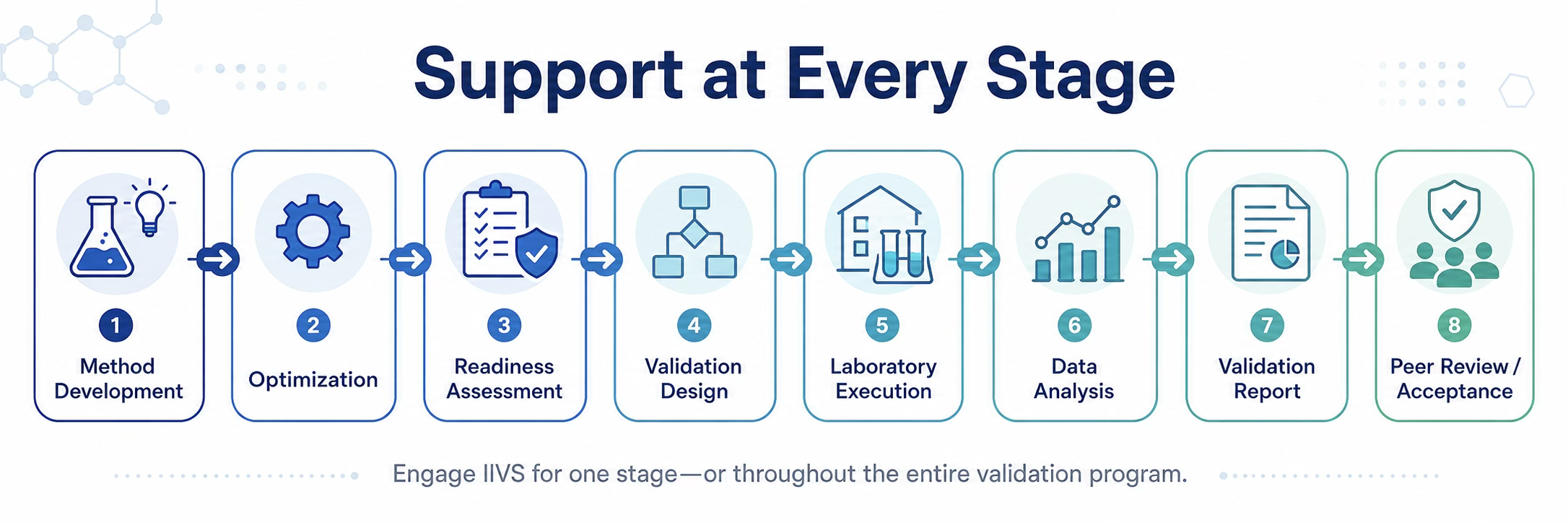
The validation process for new approach methodologies (NAMs) has evolved into a complex landscape presenting unique scientific, logistical, and regulatory challenges for method developers. From early method optimization through interlaboratory validation, data analysis, reporting, and peer review, IIVS provides the scientific expertise and quality-focused support needed to advance new methods and build scientific confidence.

Your Partner in Validation

  • By combining decades of hands-on validation experience with a deep commitment to advancing non- animal methods, our consultation services will help method developers navigate complexity, reduce risk, and accelerate the path to reach successful validation outcomes.
  • IIVS has participated in the development, evaluation, transfer, and validation of numerous in vitro and alternative methods and has extensive experience working with method developers, industry, government, and international scientific organizations.

Each Validation is Unique

Successful validation requires more than generating data. Study design, method transfer, laboratory readiness, protocol harmonization, data integrity, statistical evaluation, communication among participating laboratories, and clear reporting can all determine whether a validation program succeeds. IIVS can support individual components of a validation program or serve as an experienced partner throughout the process.

Novel Assay Development

Optimize and characterize a new or modified method before formal validation. Support may include protocol refinement, control selection, preliminary testing, transferability considerations, and development of practical laboratory procedures.

Interlaboratory Validation

Support method transfer and reproducibility across multiple laboratories. IIVS can participate as a testing laboratory, provide coordination and technical support, help harmonize procedures, review data, and contribute to validation management activities.

Regulatory / Scientific Acceptance

Help assemble the scientific and quality evidence needed for broader use of a method. Support can include data review, validation reporting, independent scientific assessment, and preparation for peer review or submission to relevant validation or regulatory bodies.

1. Validation Management Team (VMT) Leadership

We provide experienced leadership and coordination for validation studies, helping maintain alignment with regulatory and industry expectations throughout the validation process.

  • Customized project management from initial study design through study finalization
  • Coordination across participating laboratories and stakeholders
  • Technology transfer of in vitro methodologies and procedures
  • Support for efficient and transparent study execution

2. Method & SOP Optimization

Clear, transferable protocols are critical to validation success.

IIVS helps refine methods and procedures to reduce variability and improve reproducibility.

  • Refinement and clarification of Standard Operating
    Procedures (SOPs)
  • Protocol optimization
  • Identification of potential sources of variability
  • Support for method transferability and consistent laboratory implementation

3. Validation Study Design

A well-designed validation study provides the foundation for demonstrating method reliability, relevance, and reproducibility.

  • Development of validation study plans
  • Definition of study objectives and performance measures
  • Experimental design and testing strategy
  • Planning for within- and between-laboratory reproducibility
  • Alignment of study design with validation objectives

4. Method & SOP Optimization

Appropriate test chemical selection and high-quality reference data are essential for designing a meaningful and defensible NAM validation study.

  • Identification and justification of test chemicals
  • Compilation and evaluation of existing reference datasets
  • Evaluation of reference data quality
  • Selection of chemicals representing appropriate activity and response ranges
  • Development of a scientifically defensible reference set

5. Participating Laboratory Selection

Successful laboratory selection helps demonstrate that a method is robust, transferable, and reproducible outside of the developing laboratory.

  • Identification of participating laboratories
  • Development of clear laboratory qualification standards
  • Assessment of technical capabilities and readiness
  • Training and technology transfer activities
  • Coordination among participating laboratories

6. Data Governance

Transparent, well-managed data systems are critical to the credibility of a validation study and help maintain data integrity throughout the program.

  • Quality control procedures
  • Audit trail documentation
  • Validation information repositories
  • Data organization and traceability
  • Documentation management from data generation through final reporting

7. Data & Validation Auditing

Comprehensive documentation and independent review help strengthen confidence in the quality and integrity of a validation package.

  • Validation data audits
  • Documentation and report review
  • Assessment of data traceability and consistency
  • Identification of gaps or discrepancies prior to external review
  • Support from an experienced team with a strong audit history

8. Independent Peer Review

Peer review provides an independent scientific evaluation of a method and its supporting validation evidence.

  • Independent scientific assessment
  • Transparent evaluation of validation evidence
  • Review of method performance and supporting data
  • Identification of scientific or documentation gaps
    Expert feedback throughout the method lifecycle