
Author: Mitchell Gaydash
03 Jan Use of alternative test methods in a tiered testing approach to address photoirritation potential of fragrance materials
Happy New Year! IIVS is pleased to greet 2022 with the announcement of a joint publication with the Research Institute for Fragrance Materials (RIFM) involving the evaluation of photoirritation potential of over 100 compounds. This effort, spanning the course of 7 years, involved a tiered...
09 Dec IIVS e-News – December 2021
In addition to IIVS’ non-animal safety testing services, we also provide efficacy testing designed to evaluate raw materials and formulations for anti-inflammatory and skin tone modulating properties. Inflammation is a common effect experienced after encounters with irritating substances, bacterial infection or by those suffering from auto-immune...
16 Sep IIVS e-News – September 2021
It’s been a very exciting year in the field of New Approach Methodologies (NAMs) with the release of the OECD 497 and 498 Test Guidelines which have codified Defined Approaches for Skin Sensitization and the Reconstructed Human Epidermis Phototoxicity Test, respectively....
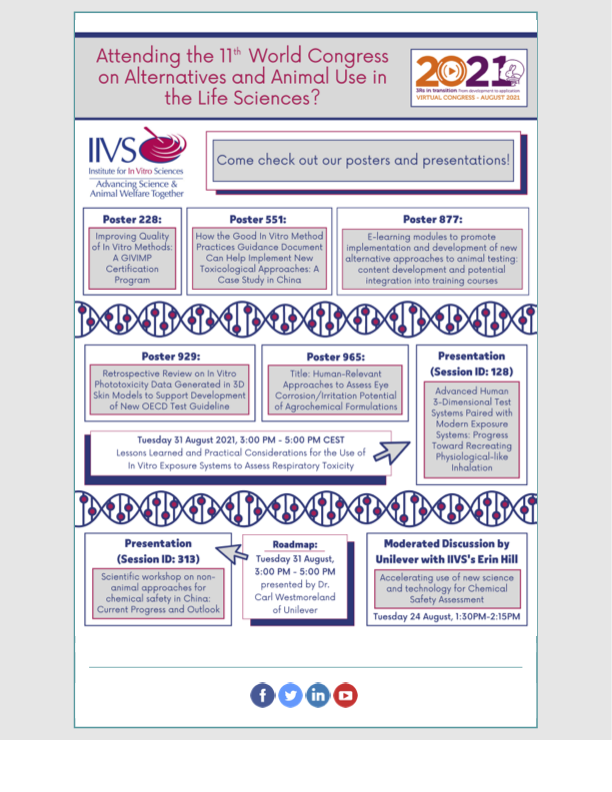
02 Aug Participation at the 2021 Annual Meeting of the American Society for Cellular and Computational Toxicology is Complimentary This Year!
As we are once again meeting online, we are pleased to announce that access to the 2021 meeting will be FREE for all attendees. However, if you are interested in helping further ASCCT’s activities, please consider becoming a member—one-year memberships for students are only $20...
30 Jun IIVS e-News – July 2021
The Defined Approaches (DAs) to Skin Sensitization Test Guideline cites 2 strategies which can be used to evaluate hazard potential of compounds and 1 strategy to evaluate GHS potency. The hazard DAs involve in vitroapproaches to the evaluation of sensitization using multiple assays which evaluate...
06 May IIVS e-News – May 2021
IIVS and the Research Institute for Fragrance Materials (RIFM) have initiated a collaboration to develop tests designed to assess potential respiratory allergens. Developing a reliable, in vitroassay to assess the allergenicity of materials to the airway tract has been an area of active research for...
20 Apr How a GIVIMP Certification Program Can Increase Confidence in In Vitro Methods
Regulatory bodies, validation authorities, method developers, and industry toxicologists realize the need to increase confidence in the scientific validity of novel in vitro methods – especially those being proposed for regulatory application ....
20 Apr IIVS Co-Publishes Article on Ocular Animal Model Alternatives
The human eye may be exposed to chemicals through various situations, such as accidental splashing or exposure to chemical particles, vapours or gases. Workers and consumers are usually advised to immediately wash eyes generously with water following exposure....